OUR SERVICES
Focused Expertise. Stronger Compliance. Better Outcomes.
Every healthcare organization faces unique operational and clinical challenges. Our specialized services are designed to strengthen documentation accuracy, improve care coordination, support regulatory compliance, and help providers deliver measurable results across the entire patient care journey.

Specialized Support for Every Stage of Patient Care
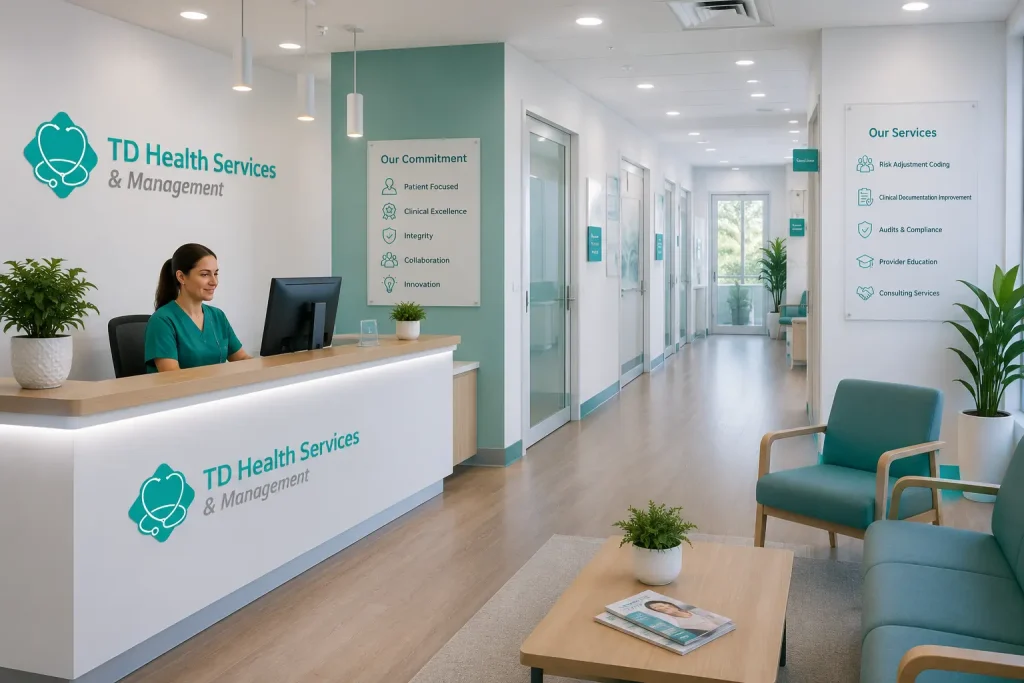
TD Health Services and Management offers five focused service lines, each addressing a different point in the patient care and reimbursement cycle: documentation accuracy, chronic condition management, preventive evaluation, risk adjustment coding, and coordination across providers. Rather than treating these as separate transactions, we run them as a connected practice, so findings from an audit inform coding accuracy, and coding accuracy supports the quality metrics tracked through care coordination.
Every service is delivered by specialists with direct healthcare experience, not general administrative staff working from a checklist. That distinction matters in a field where the difference between a compliant chart and a flagged one often comes down to a single missing detail. Below is a closer look at what each service actually involves, the standards it’s held to, and the outcomes organizations can expect when they bring us in.
01 / Service
Medical Record Audits
A medical record audit is a structured review of clinical charts against the regulatory, payer, and internal quality standards your organization is required to meet. We look for documentation gaps that could trigger denials, coding inconsistencies that don’t match what was actually performed, and missing signatures, timestamps, or clinical justifications that auditors flag first. The goal isn’t to catch your team doing something wrong; it’s to find the small, fixable issues before a payer or regulator does. Medicare RAC audits, commercial payer reviews, and internal compliance checks all look for the same patterns, and most of them are preventable with a second set of trained eyes.
Each audit produces a clear, prioritized report: what’s compliant, what needs correction, and what’s putting the organization at risk of denied claims or regulatory penalties. We don’t just list problems, we walk your team through the fix, whether that’s a documentation template adjustment, additional provider training, or a change to how records are finalized before submission. Organizations that run regular audits typically see fewer denied claims, faster reimbursement cycles, and cleaner results when a payer or CMS contractor requests records.
We typically recommend audits on a recurring basis rather than a one-time engagement, since documentation habits drift over time as staff turnover, EHR templates change, and payer requirements are updated. A quarterly or semi-annual cadence catches issues while they’re still small, rather than after a full year of records has accumulated the same mistake.
What this includes
- Regulatory compliance
- Documentation accuracy
- Identification of improvement opportunities
- Clinical process optimization


02 / Service
Chronic Care Management
Chronic Care Management (CCM) provides structured, ongoing support for patients living with two or more chronic conditions, most commonly type 2 diabetes, hypertension, chronic kidney disease, and hyperlipidemia in the populations we support. Rather than waiting for the next scheduled visit, our team maintains monthly contact with enrolled patients: reviewing medications, checking in on symptoms, answering questions about their care plan, and flagging anything that looks like it’s trending toward a complication or an avoidable emergency room visit.
This isn’t just a check-in call. Each monthly touchpoint is documented to CMS CCM billing requirements, so the service supports both patient outcomes and appropriate reimbursement for the time spent managing complex patients between visits. For provider organizations, that means better continuity for patients with the highest risk of hospitalization, and for practices operating under value-based contracts, it directly supports the quality and utilization metrics those contracts are built around.
Enrollment and outreach are handled with the patient’s existing care team in mind, not as a parallel program running independently of the practice. Providers stay informed of what’s discussed during monthly outreach, and any concerning findings are escalated back to the care team the same day rather than sitting in a monthly summary.
What this includes
- Type 2 diabetes, hypertension, CKD, and hyperlipidemia
- Patient education
- Monthly follow-up
- Prevention of complications
- Care coordination


03 / Service
Annual Wellness Visits
An Annual Wellness Visit is a full, once-a-year evaluation of a patient’s health status, not a problem-focused visit, but a structured look at where things stand overall. We review the patient’s full medical history, current medications, and any changes since the last visit, then screen for risk factors that might not come up during a routine appointment focused on a specific complaint.
The result is an updated care plan built around what the data actually shows: gaps in preventive screenings, medication conflicts worth a second look, and risk factors worth addressing before they become diagnoses. For provider organizations, consistent AWV completion also supports quality reporting requirements and gives care teams an accurate, current picture of every patient on their panel, not just the ones who come in regularly.
We coordinate scheduling so wellness visits don’t compete with a practice’s regular appointment volume, and we handle the documentation load that often causes AWVs to get deprioritized in busy practices. The visit itself follows CMS’s required components exactly, so there’s no ambiguity about whether it qualifies for billing.
What this includes
- Early disease detection
- Clinical history updates
- Medication review
- Risk factor identification
- Personalized prevention plans


04 / Service
Risk Adjustment Coding
Risk Adjustment Coding translates clinical documentation into the CMS/HCC coding structure that Medicare Advantage and other value-based programs use to determine appropriate reimbursement. Our coders are trained specifically in HCC methodology, which means they know the difference between a condition that’s simply mentioned in a chart and one that’s actually documented well enough to support a code, and they know how CMS audits look for that difference.
Done well, this work does two things at once: it protects the organization from the compliance risk of over-coding or unsupported diagnoses, and it makes sure providers aren’t leaving legitimate, well-documented conditions uncoded and unreimbursed. Both directions matter. Under-coding costs revenue the organization has already earned through the care it delivered; over-coding creates audit exposure. Accurate coding threads that needle consistently, visit after visit.
Coders work directly from the clinical documentation in the chart, never inferring a diagnosis that isn’t explicitly supported. When documentation is ambiguous, we flag it back to the provider for clarification rather than guessing, which protects both the accuracy of the code and the provider’s own compliance standing.
What this includes
- Precise documentation
- CMS/HCC compliance
- Reimbursement optimization
- Accurate risk adjustment coding

05 / Service
Care Coordination & Quality Improvement
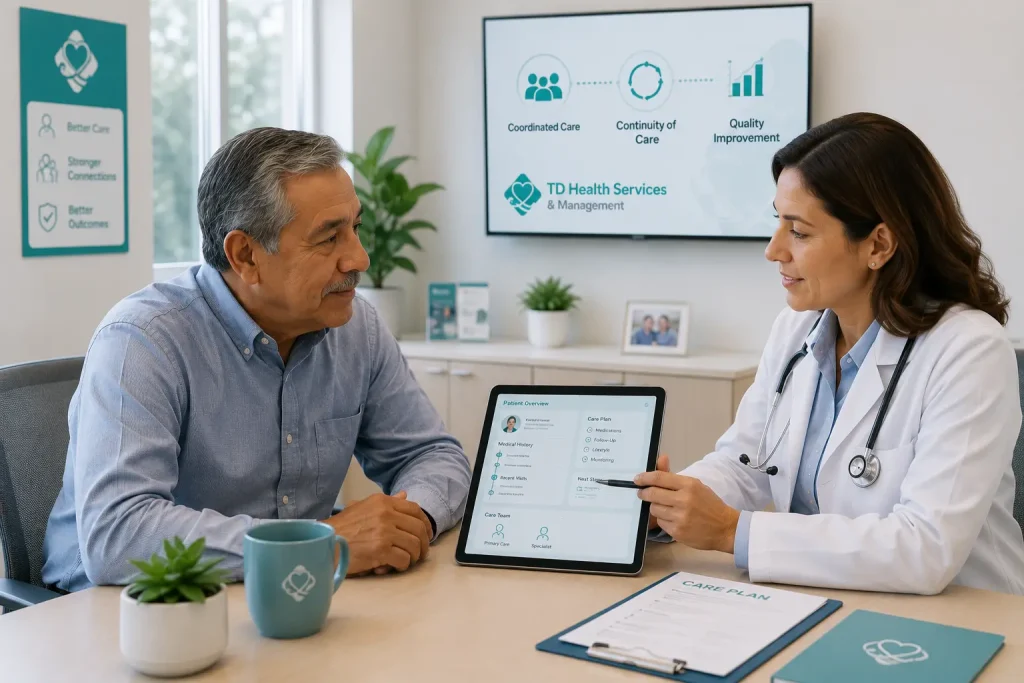
Care Coordination keeps the people involved in a patient’s care, primary care providers, specialists, care managers, and sometimes family caregivers, working from the same information. When a patient sees a specialist, that information needs to make it back to their primary provider. When a hospital discharges a patient, someone needs to make sure the follow-up appointment actually happens. We build and manage those connections so continuity of care doesn’t depend on the patient remembering to make a phone call.
Alongside coordination, we track the quality metrics your organization is accountable for, whether that’s tied to a value-based contract, a quality reporting program, or simply an internal standard for what good care looks like. That means identifying where indicators are slipping, understanding why, and building a practical plan to close the gap, not just a dashboard that shows the problem without a path to fixing it.
In practice, this often means we’re the ones tracking whether a referral was completed, whether discharge instructions were followed, and whether a specialist’s recommendations made it into the primary care record. Small gaps like these are where continuity of care most often breaks down, and where the biggest improvements in quality metrics tend to come from.
What this includes
- Coordination between providers
- Patient follow-up
- Continuity of care
- Quality strategies
- Clinical indicator optimization

How It Fits Together
One Coordinated Practice, Not Five Separate Vendors
These five services are designed to work together rather than as isolated offerings. An audit surfaces where documentation falls short; risk adjustment coding depends on that same documentation being accurate to begin with; chronic care management and annual wellness visits generate the ongoing clinical detail that keeps both the audit and the coding current; and care coordination makes sure none of that work gets lost between the specialists, primary care providers, and administrative staff involved in a patient’s care.
Organizations don’t need to start with all five. Many begin with a single audit to understand where they stand, then add chronic care management or risk adjustment coding once the documentation foundation is solid. Others come to us already running most of these functions in-house and need a second, independent review to confirm their own processes hold up. Whichever way an organization starts, the goal is the same: patient records and processes that reflect the actual quality of care being delivered, and hold up when someone outside the organization takes a closer look.
Ready to Improve Healthcare Performance?
Partner with TD Health Services and Management — request a consultation and talk to our team this week.